Automatically map your business logic, metrics, and definitions across all your systems

Continuously resolve mismatches, anomalies, and schema drift without manual intervention

Deliver structured, contextualized intelligence directly to copilots, dashboards, and decision workflows


On Wednesday, Snowflake CEO Sridhar Ramaswamy asked Databricks to “release all the numbers,” wondering aloud whether 80% growth shrinks to 65% once pass-through inference is stripped out. Ali Ghodsi replied that the two companies are complementary, then suggested Snowflake buy its AI tokens through Databricks “since you’re not doing this AI stuff.”
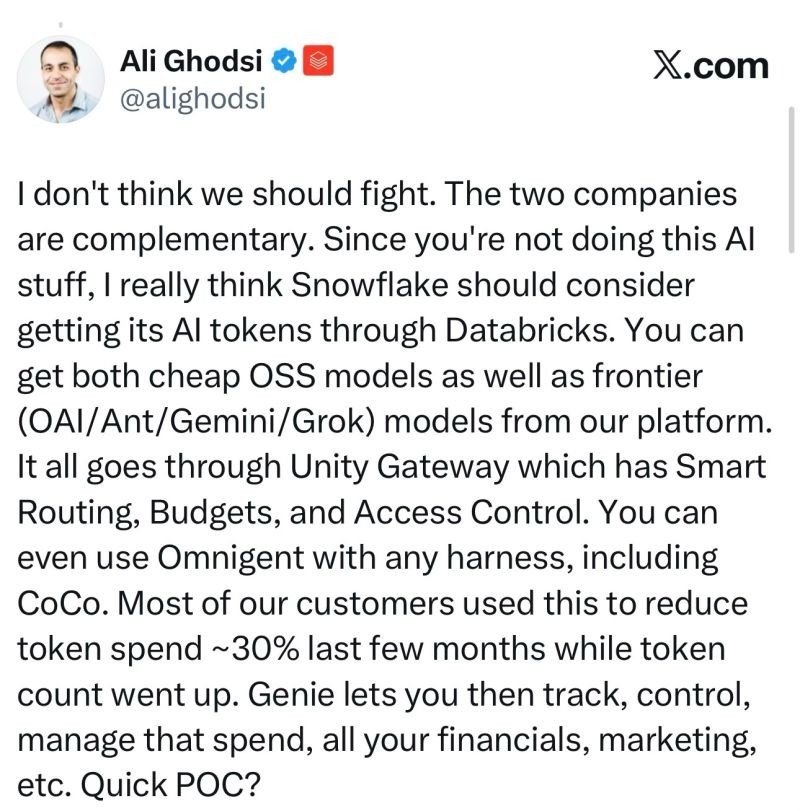
I mean, pass the popcorn, because let’s be frank: this is great theatre. But while two CEOs argued about whose numbers were real, most of their customers had a quieter version of the same problem: their own numbers don’t agree with each other, and neither platform can see it.
Storage is settled. Meaning isn’t.
For a decade, this was an argument about where your data lives. That one is over. Iceberg became the shared table format, both companies backed it, and the competition moved to governance, agents and AI services.
The new fight is over meaning. Snowflake shipped Semantic Views, which define metrics and relationships so Cortex agents write correct SQL. Databricks shipped Metric Views in Unity Catalog to do the same for Genie. Both are good, and both come included with your compute.
Both also come with the same small print. Snowflake’s definitions cover data in Snowflake. Databricks’ cover data in Databricks. Run both, and you have two sets of definitions that have never met.
What that looks like on a Tuesday
Take a bank that runs risk on Databricks and regulatory reporting on Snowflake, a split that shows up often in financial services. Each team defines “active deposit account” in its own semantic layer. Each definition is governed, documented and signed off.
Now say one excludes dormant accounts after 12 months and the other after 18. Nobody notices, because each layer can only see its own warehouse. Then someone asks an agent a question that spans both, and the agent picks one definition with total confidence.
Meanwhile, the number the CFO actually signs is assembled in a spreadsheet pulling from the ERP, the core banking system and both warehouses. No semantic view covers that spreadsheet.
The market knows this gap exists. Ironically, on the same day Ghodsi and Ramaswamy got heated on X, Google added a feature to its catalog that flags when Snowflake and Databricks define a metric differently. But it still doesn’t fix the problem. Flagging is the easy part. Someone still has to work out which definition is right, fix it everywhere, and prove it to an auditor.
That’s the part we do
Preql connects the warehouses, the ERP, the CRM, billing and the spreadsheets. It finds where definitions disagree, down to the records, and settles them at the source, with a named owner and a full audit trail of where every number came from. Every agent, dashboard and workflow then reads the same answer, whichever platform it runs on.
Snowflake and Databricks are superb at governing what lives inside them. Preql handles everything that doesn’t.
The future we are building
I run a company that sits across both platforms, so weigh this accordingly. The warehouse wars end in a draw. Everyone runs both, plus several systems neither warehouse ever sees. The companies that come out ahead will be the ones that treat meaning as something they own, not something their vendor’s catalog happens to hold.
Pick either platform. Own the definitions yourself.
If your metrics live in more than one place and you suspect they quietly disagree, message me. They usually do. And if you think one of these two wins outright, tell me which and why. Like those two, I love an argument.
What I've been up to…
Conference season has me living in Vegas, and one question keeps coming up: what makes AI useful inside a business, beyond the art-of-the-possible demo?
Money20/20: Talked agentic banking with Andrew Lambert of Cross River. When agents share a context layer, every new use case builds on the last.
Off the floor: A poolside cabana with Stack.VC, and dinner with Christina (Valli Ventures) and Clare (Goldman). The small rooms are where the real conversations happen.
JPMC: Presented Preql at JPMorgan Chase with my Columbia capstone class. Teaching them this semester has been a highlight.
Central Park: Shooting and strolling with my favorite customer, Savannah Davvy of Protos Security.



Where I'm headed next
Charlotte, Nov 7: Banking Transformation Summit with the brilliant Marc Rehberger, on what makes a bank ready to adopt new tech.
AFP, Las Vegas, Nov 10: Giving treasury and finance teams trusted context so AI can do real work.
FATE, NYC, Nov 18–19: The shared definitions underneath the finance stack. Home turf. I’m also hosting special events with Brex that week, so DM me for details.
Fintech NerdCon, San Diego, Nov 19–20: No booths, just builders.
AWS re:Invent, Las Vegas, Nov 30–Dec 3: Better models need business context to be useful.
Back in two weeks.
Gabi
Explore more